| About |
SAMCAR Directors Adopt 2026-2028 Strategic Plan
The SAMCAR Board of Directors adopted the 2026-2028 Strategic Plan at their November 2025 meeting, subsequent to a Strategic Planning retreat in October 2025.
In October, directors reviewed and updated the Association's SWOT (Strengths, Weaknesses, Opportunities and Threats) analysis via a comprehensive survey aimed at evaluating SAMCAR's position and identifying strategic priorities and key performance indicators (KPIs).
Following the SWOT survey, SAMCAR Director of Brand and Communications, Dalen Gilbrech, facilitated a strategic planning workshop held in October. At this session, SAMCAR directors and directors-elect engaged in small group brainstorming exercises to develop goals, objectives and strategies for the current iteration of the Strategic Plan. Groups considered areas of the previous plan that were particularly successful and those that needed attention in their effort to align association needs and aspirations with existing capabilities and potential new resources.
The resulting three-year plan focuses on strategic initiatives that broadly align with key priorities: direct engagement (the "go to the people" initiatives), thought leadership (competence and content strategy), and procedural integrity (evaluating, rationalizing and documenting).
2026-2028 STRATEGIC PLAN
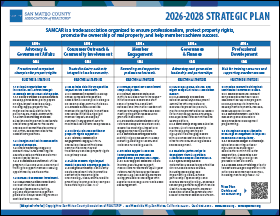
2026-2028 Strategic Plan 
Key performance indicators (KPIs) to measure effectiveness fall into four categories: Member Participation (program attendance, committee service), Community Presence (local partnerships, community event sponsorship), Sustaining Investment (Realtor Action Fund, membership renewals), and Media Reach (earned, owned, and social media).
A Strategic Plan is among the guiding documents for the association. It is informed by the aspirational vision and mission statements, governed by the bylaws, policies & procedures and National Association of Realtors (NAR) Core Standards, and directs the annual budget and operations to align with strategic priorities.
All local associations are required to annually comply with National Association of REALTORS® Core Standards, which require that the association maintains a Strategic Plan. NAR and C.A.R. recommend that the local association strategic plan contain Diversity, Equity and Inclusion (DEI), Fair Housing, and Advocacy components. Additionally, Core Standards require completion of specific programs and initiatives including Vote/Act/Invest, REALTOR® Safety, professional development, leadership training, and consumer outreach / community involvement.
The Board of Directors will assign staff, committees, and task forces responsibility for individual sections of the Strategic Plan and subsequent initatives.
Questions? Contact SAMCAR Staff at samcar@samcar.org
PLAN DASHBOARD »
2026-2028 Strategic Plan
[Adopted 11/19/2025]
Mission Statement
SAMCAR is a trade association organized to ensure professionalism, protect property rights, promote the ownership of real property, and help members achieve success.
Area 1 - Advocacy & Government Affairs
SAMCAR is a proactive and competent champion for property rights.
-
1.1 Establish reputation for influential, data-driven thought leadership on local real estate policy.
-
1.1.1 Policy Position Documentation: Develop professional policy papers on high-impact local issues (e.g., housing supply, property tax, major ordinances), distribute to policymakers, media, community.
-
1.1.2 Position Vetting Protocol: Establish and implement a deliberate and internal process for the Board and relevant committees to formally vet, affirm, and communicate the association's positions.
-
-
1.2 Strengthen direct influence with local policymakers.
-
1.2.1 Policy Briefings: Regularly conduct face-to-face meetings to educate elected officials and staff on relevant policy issues.
-
1.2.2 Candidate Recruitment: Utilize programs like CCRE Local Government training to support members seeking appointments / elected office.
-
-
1.3 Increase stakeholder investment.
-
1.3.1 REALTOR® Action Fund (RAF): Conduct volunteer-led donor outreach (phone bank, texting, e.g.) and major donor recognition publication and/or event to grow RAF contributions volume.
-
Area 2 - Consumer Outreach & Community Involvement
SAMCAR is a trusted industry authority integral to the local community.
-
2.1 Maximize visibility and positive impact on the community.
-
2.1.1 Community Summit: Develop annual symposium to position association as hub of public dialogue on local housing, community issues.
-
2.1.2 Public Service: Mobilize members to participate in charitable and service initiatives, highlight member impact, and deploy Community Engagement Fund to maximize association's local presence.
-
-
2.2 Cultivate diverse coalition of property rights supporters.
-
2.2.1 Diverse Community Engagement: Engage, inform, and build alliances with diverse communities who may not traditionally consider property rights as a primary value.
-
-
2.3 Utilize modern, high-impact media to educate and engage public.
-
2.3.1 Digital Authority: Consistently create and disseminate informative content with modern digital channels (e.g., video, shorts, reels) to proactively inform public on complex real estate topics. (See: 1.1.1)
-
Area 3 - Member Engagement
SAMCAR is a rewarding and supportive professional network.
-
3.1 Increase volunteer commitment and participation.
-
3.1.1 Direct Member Outreach: Institute sustained "Go to the People" initiative where leaders and staff conduct proactive, consistent outreach and information sessions at member brokerage offices and local meetings to gather feedback and promote involvement.
-
3.1.2 Volunteer Enthusiasm: Clarify nature and scope of volunteer roles, reward the most high-impact and engaged member volunteers.
-
3.1.3 Maintain Meetings/Events: Maintain highly successful Tuesday Marketing Meeting on Zoom, and social and fundraising events.
-
-
3.2 Provide support resources to help members overcome professional, personal challenges.
-
3.2.1 Peer Support Network: Create informal peer-to-peer support mechanisms for members (opt-in peer network facilitated by experienced members, e.g.) connecting members facing professional challenges with experienced colleagues for advice and encouragement.
-
Area 4 - Governance & Finance
SAMCAR is advancing next generation leadership and partnerships.
-
4.1 Ensure prepared, diverse, and highly competent future association leaders.
-
4.1.1 Leadership Succession: Establish Leadership Development Committee with mandate and resources to proactively recruit, mentor, and promote diverse leaders (in terms of background, brokerage, and experience) into committee and Board positions.
-
4.1.2 Mentorship Program: Establish a formal, structured leadership mentorship program to pair high-potential emerging leaders with seasoned Past Presidents and Directors for one-on-one guidance and development.
-
-
4.2 Maximize partnerships to strengthen financial position, rationalize collaborative ventures.
-
4.2.1 Sponsorship Redux: Systematically evaluate opportunities for non-dues revenue sources, including developing and implementing viable, rational partnerships, sponsorships, and revenue share options (e.g., endorsed vendor programs) to support financial stability, resource growth, member value and rationalize parameters for access to member audience outreach.
-
Area 5 - Professional Development
SAMCAR is the hub for training resources and supporting member success.
-
5.1 Provide relevant training that contributes to member success.
-
5.1.1 Member Surveys: Conduct comprehensive member needs assessment surveys and program follow-up surveys to inform the development of dynamic, focused, needs-based curriculum.
-
5.1.2 Maintain Panels: Maintain successful panel discussions and professional development programming.
-
-
5.2 Strengthen cooperation with brokerage management to improve new member competency.
-
5.2.1 Broker/Manager Partnership: Establish a recurring series of high-level Broker/Manager and Director Summits to foster cooperation, standardize new member training, and align on professionalism standards.
-
5.2.2 New Member Training: Directly translate brokerage cooperation into actionable new member resources, including mentorship (see: 4.1.1).
-
The previous Strategic Plan was adopted in December 2022. The 2026-2028 Strategic Plan replaces the previous plan pursuant to its adoption on 11/19/2025.
See also: